
Crackstube Explained starts with a simple problem: the name means different things depending on where you read it. Some pages describe crackstube.com as a general website that publishes articles on technology, finance, education, and business. Other pages use the same word for cracked software and pirated streaming. If you only skim search results, it is easy to come away confused or misinformed.
This guide separates those two meanings so you can judge the situation clearly. You will learn what crackstube.com currently presents itself as, how to verify the exact domain, and how to tell whether its articles are reliable. We also cover the real risks of cracked software and pirated streaming, along with practical steps to protect your device and personal data.
What Is Crackstube, and Why Are Search Results So Different?
If you search for “Crackstube,” you will not get one consistent answer. Some pages describe it as a general website that publishes articles. Others treat it as a label for sites that offer cracked software, free movies, or pirated streams. A reader sees two very different pictures and cannot easily tell which one is accurate.
This mix-up happens because the word is not a protected brand with one clear owner. Anyone can register a domain with a similar name, and anyone can write an SEO article that uses the term loosely. Over time, the keyword collects content from unrelated sources. The result is a confusing search page where the facts about one site are blended with opinions about another.
The practical lesson is to separate the name from the exact website. Before you trust or reject anything you read, find out which domain the author means. A review of a pirated streaming site tells you nothing about a blog on a different domain. Starting with that distinction makes the rest of your research far more reliable.
What Crackstube.com Currently Presents Itself As
At the time of writing, crackstube.com presents itself as a general publishing website rather than a software download portal. Its public pages are described as covering topics such as technology, finance, education, and business. That positioning is closer to a niche blog or content site than to a file-sharing platform. You should still confirm this on the live site yourself.
A website’s self-description is only a starting point, not proof. Many sites describe themselves as informational while serving thin content or heavy advertising. Look at what the pages actually contain, how they are organized, and whether the stated purpose matches the experience. If the homepage and the articles agree with each other, that is a good sign.
Why “Crackstube” Can Refer to Different Websites or Contexts
The word combines “crack” and “tube,” and both parts carry baggage online. “Crack” often points to cracked software, meaning programs with licensing protections removed. “Tube” suggests video sharing, as in YouTube-style platforms. Together they sound like a place for pirated downloads or streams, which is how many third-party articles use the term.
Because of that reputation, several writers use “Crackstube” as a catch-all label for risky free-content sites. Those articles often describe pop-ups, redirects, and malware without naming one verified domain. That is why the same keyword can appear in a safety warning and a publishing guide. Always ask which site the writer actually examined.
Why the Exact Domain Name Matters
A single changed letter can lead to a completely different website. Scammers and copycat operators register near-identical domains to catch mistyped searches. One spelling might lead to a harmless blog and another to a page full of aggressive ads or fake download buttons. The name looks familiar, so people lower their guard.
Checking the exact domain is the fastest safety habit you can build. Read the full address in the browser bar, including the ending such as .com, .net, or .org. Do not rely on a search snippet or a social media link. Typing the address yourself removes most of the risk that comes from lookalike sites.
What Does Crackstube.com Publish?
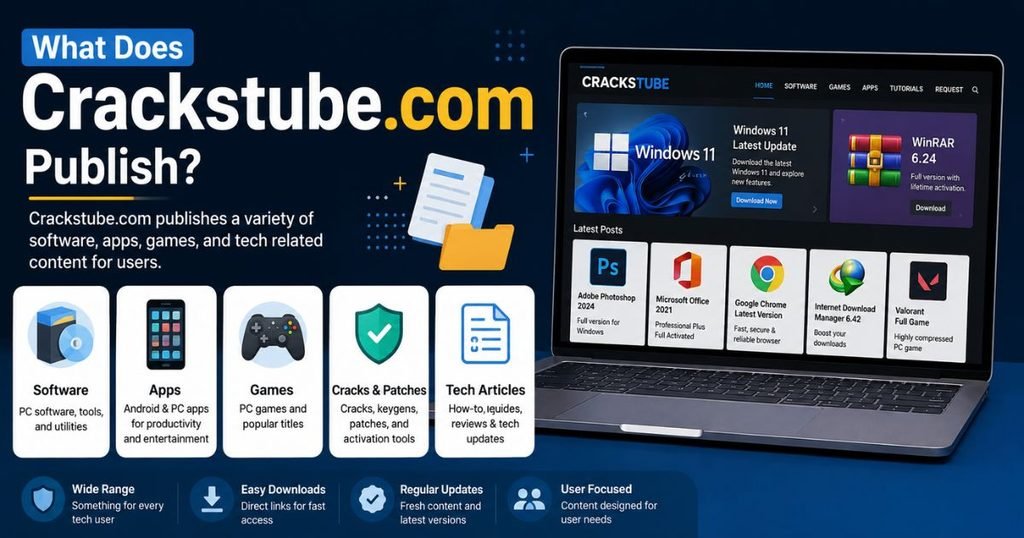
Based on public descriptions, crackstube.com is positioned as a multi-topic article site. It does not appear to focus on one narrow niche. Instead it covers several broad areas that attract everyday search traffic, such as practical technology advice, money topics, and learning resources. This kind of site usually targets readers who want quick explanations rather than deep specialist analysis.
Multi-topic sites can be useful, but their quality varies from article to article. One post may be well researched while the next is a short, generic overview. Because the topics are so broad, no single editor is likely to be an expert in all of them. Readers should judge each article on its own merits.
It also helps to look at how often new content appears and how the posts are presented. A steady flow of clearly dated, well-structured articles suggests active editorial care. A site that publishes irregularly, repeats the same ideas, or hides authorship deserves more caution. The publishing pattern tells you as much as the topics do.
Technology, Finance, Education, and Business
Technology and business are common topics for general blogs because they attract steady search interest. On a site like this, you might find explainers about apps, digital tools, online services, or work-related advice. These articles are most helpful when they give clear steps and name the products they discuss. Vague summaries without specifics are less useful.
Finance and education need extra care because mistakes can affect real decisions. A finance article should never replace advice from a licensed professional, and an education article should point to credible sources. When a post makes claims about money, loans, or study programs, check them against official or primary sources. Treat the article as a starting point, not a final answer.
Other Topics and Broader Content
Beyond the main categories, sites like this often add lifestyle, entertainment, health, travel, or general-interest posts. These broader topics help a site reach more search queries, but they can also dilute its focus. A reader should ask whether the writer has real knowledge of each subject. Wide coverage without clear expertise is a common warning sign.
Pay particular attention to health and legal topics, where poor information can cause harm. If a post makes medical or legal claims, look for named experts and references to reputable organizations. Content that is anonymous, undated, and unsourced should be treated as opinion only. Broader content is not bad by itself, but it needs stronger proof of quality.
How Can You Tell Whether a Crackstube.com Article Is Reliable?
Reliability is something you test, not something you assume from a site’s design. A clean layout and confident tone are easy to copy, so they prove very little. A better approach is to check who wrote the article, when it was written, and what evidence supports it. These three checks take only a few minutes.
Apply the same standard you would use for any blog or news site. Ask whether the article answers the question it promises to answer. Notice whether it avoids exaggerated claims, such as guaranteed results or “secret” methods. Reliable writing usually sounds measured and admits limits where they exist.
It also helps to compare the article with at least one outside source. If several trustworthy sources agree with the main points, your confidence can rise. If the article makes surprising claims that nobody else repeats, be skeptical. Careful readers build trust in layers instead of accepting a single page at face value.
Check the Author and Publication Date
A named author with a visible background makes an article easier to evaluate. Look for a short bio, links to other work, or professional profiles that show real experience. If the page lists no author or only a generic team name, you cannot judge their expertise. That does not make the content wrong, but it lowers trust.
The publication date matters just as much, especially for fast-moving topics. Technology advice, tax rules, and online safety guidance can become outdated within months. An article with no date, or one that was never updated, may describe conditions that no longer apply. Look for “last updated” notes and be cautious without them.
Look for Sources and Supporting Evidence
Good articles show where their information comes from. They link to official websites, studies, government pages, or recognized industry sources. When a claim includes a statistic or a rule, a source should be easy to find. Links that go nowhere or point only to other pages on the same site are not strong evidence.
Check whether the sources actually support the statement being made. Writers sometimes link to a page that only loosely relates to the claim. Open a few links and read the relevant section yourself. If the evidence is thin or missing, treat the claim as unverified until you confirm it elsewhere.
Compare Important Claims With Primary Sources
A primary source is the original place where information is published, such as a regulator, a company’s own documentation, or a research paper. For anything important, go there directly instead of relying on a summary. This is especially true for money, health, legal, and security topics. Primary sources are more accurate and easier to hold accountable.
When the blog and the primary source disagree, trust the primary source. Summaries can contain errors, leave out conditions, or reflect old information. If you cannot find any primary source that backs up a key claim, do not act on it. A few minutes of checking can prevent costly mistakes.
What Current Public Pages Show
Public pages about “Crackstube” fall into two broad groups. The first group is general-interest content that describes crackstube.com as a publishing website. The second group is a large set of SEO articles that treat the term as a label for cracked software or pirated media sites. Many of these pages repeat each other and offer no first-hand testing.
The tone of these pages also differs. Warning articles usually mention malware, intrusive ads, and legal risk, but they rarely show screenshots or technical evidence. Neutral pages tend to describe topics and structure without making strong claims. Neither type should be accepted automatically.
A useful way to compare them is to put the main findings side by side, as in the table below.
| Type of Source | What It Usually Claims | How Much to Trust It |
| Crackstube.com’s own pages | General articles on tech, finance, education, business | Moderate; self-description needs checking |
| SEO “guide” articles | Cracked software or pirated streaming | Low to moderate; often vague and repetitive |
| Security scanner reports | Domain age, hosting, threat signals | Higher; based on technical data |
| Independent reviews with evidence | Specific findings with screenshots or tests | Higher, if the author is identifiable |
Why the Name Causes Confusion
Names that combine popular internet terms are easy to confuse. “Crackstube” echoes “Crackstreams,” a well-known type of unauthorized sports streaming site, and it also resembles words like “Crackle,” which is a separate legal streaming service. Readers mix these names up, and so do writers who are rushing to publish. Each mistake spreads through copied content.
Search engines add to the problem. They show pages that match the keyword, not pages that are guaranteed to be about the same website. When several low-quality articles use the term differently, the results become a patchwork. A reader may assume they all describe one place when they do not.
The best defense is patience. Read the first few paragraphs of any article to find which site it covers. Look for the exact domain, a screenshot, or a direct link. If an article never names a clear address, you should not apply its warnings or praise to any specific website.
What Is Crackstube? Start With the Exact Domain
The simplest honest answer is that “Crackstube” is a name, and a name alone does not define a website. To know what a site is, you have to look at the exact domain and what it actually does. For crackstube.com, public descriptions point to an article-based publishing site. For other uses of the term, the meaning can be very different.
Starting with the domain helps you ask better questions. Who owns it, and when was it registered? What pages does it show, and does it ask for logins, payments, or downloads? These details say more than any keyword-based summary. A WHOIS lookup or a reputable URL scanner can give you quick answers.
Keep in mind that domain information can change. Sites are sold, repurposed, or redesigned, and an old domain can start serving different content. That is why a check done today is more useful than an old review. Recheck when you return to a site after a long break.
CracksTube.com, Similar Domains, and Unrelated Lookalikes
Different capitalization and spelling can create the impression of several sites. “CracksTube,” “Crackstube,” and “Cracks Tube” may be treated as the same thing in articles, yet they can map to unrelated domains. Domains are not case sensitive, but the surrounding words, extensions, and hyphens can change completely. Always verify the full address.
Lookalike domains are a known tactic for traffic diversion and scams. Operators register variations such as extra letters, swapped endings, or added hyphens. Some of these pages copy a trusted layout to look legitimate. Others simply fill the screen with ads and redirects once a visitor lands.
To avoid lookalikes, bookmark the correct address after you have verified it. Use official links from the site’s own pages rather than search ads or social posts. If something looks slightly off, such as unusual fonts, broken pages, or a surprise download request, leave immediately. Caution costs nothing and can protect your device and data.
Is Crackstube Safe? Assess the Action, Not Only the Name
Safety depends on what you do on a site, not just on its name. Reading a plain article is a low-risk action. Creating an account, entering payment details, installing software, or allowing notifications is higher risk. The same website can be fine for one activity and risky for another.
This is why a simple yes or no answer is often misleading. A site can look harmless and still carry intrusive ads or unclear data practices. Another site can have a bad reputation and still be harmless if you only read a page and leave. What matters is how much trust you extend and what you risk by doing so.
A useful habit is to match your caution to the action. Browsing needs basic protection such as an updated browser and a blocker for pop-ups. Sharing personal details or downloading files needs much stronger proof that the site is legitimate. If the proof is not there, do not proceed.
How to Judge Crackstube Content for Trustworthiness
Trustworthy content has visible accountability. You can see who wrote it, who runs the site, how to contact them, and what rules they follow. You can also see how they handle corrections. When these elements are missing, you have no way to hold anyone responsible for mistakes.
Content quality shows up in the writing itself. Strong articles answer a specific question, give concrete examples, and avoid filler. Weak ones repeat the keyword, make broad claims, and end without a clear takeaway. Reading a few posts side by side quickly reveals the difference.
Finally, test the content against the real world. Do the facts match what official sources say? Do the instructions work as described? If an article gets basic details wrong, you should doubt the rest. Trust should be earned through accuracy, not assumed from a polished appearance.
The Legitimate Publishing Side of Crackstube

On the legitimate side, crackstube.com is described as a site that publishes articles on topics such as technology, finance, education, and business. Sites like this can serve a real purpose by offering short, readable explanations. Many readers prefer them for quick answers and general orientation. A well-run version would credit authors and keep its content current.
Running a legitimate content site also means following basic standards. That includes clear contact details, privacy and terms pages, and honest labeling of sponsored posts. These elements show that the owners expect to be held accountable. Their absence is a reason to look more closely.
It is fair to say that a publishing site is not automatically risky because of its name. The name may be unfortunate, but judgment should rest on the site’s actual behavior. Evaluate its pages, policies, and content quality directly. If they hold up, the name matters much less.
The Cracked Software and Streaming Side
The other meaning of “Crackstube” connects to cracked software and pirated media. Cracked software is a paid program that has been altered to bypass licensing. Pirated streaming offers movies, shows, or sports without permission from the rights holders. Many third-party articles use “Crackstube” as shorthand for this whole category.
These sites commonly rely on aggressive advertising, pop-ups, and redirect chains. Some push fake download buttons or ask visitors to enable browser notifications. Others bundle unwanted programs with the files they offer. The business model usually depends on ad clicks, not on the quality of the content.
It is important not to confuse this category with a specific domain unless there is evidence. An article that describes cracked software in general does not prove that crackstube.com offers it. Equally, a clean-looking site does not erase the risks of the wider category. Keep the two ideas separate when you research.
Real Risks of Cracked Software and Pirated Streaming
The most serious risk is malware. Cracked installers are a common way to spread trojans, information stealers, and ransomware, because users willingly disable their antivirus to run them. A single infected file can expose saved passwords, banking details, and personal documents. Recovering from that can take weeks.
There are also legal and practical risks. Distributing or using copyrighted material without permission can violate copyright law, and the consequences differ by country. Cracked software also receives no official updates or support, so it may crash or leave security holes open. The money you save can disappear quickly.
| Risk | What It Means for You |
| Malware and stealers | Stolen passwords, financial data, or locked files |
| Intrusive ads and redirects | Scam pages, fake alerts, unwanted notifications |
| Legal exposure | Possible copyright claims or penalties, depending on your country |
| No updates or support | Bugs, crashes, and unpatched security flaws |
| Data privacy | Hidden tracking and no clear policies on how data is used |
Simple Steps to Protect Yourself Online
Start with the basics. Keep your browser, operating system, and security software up to date. Use a reputable antivirus, and never disable it to install a file. A password manager with unique passwords limits the damage if one account is exposed.
Be selective about permissions and downloads. Refuse notification requests from sites you do not know, and avoid installing browser extensions unless they come from official stores. Download software only from the developer’s website or a trusted marketplace. If an offer sounds too good to be true, it usually is.
Finally, build good habits for checking websites. Verify the full domain, read the policy pages, and use a URL scanner when you are unsure. Turn on two-factor authentication for important accounts. If you think you have installed something harmful, disconnect from the internet, run a full scan, and change your passwords from a clean device.
Is Crackstube.com Safe to Use?
For simple reading of articles, crackstube.com may carry lower risk than a pirated download site, but no website should be called safe without checking. Safety depends on the current state of the site, its advertising, and your own behavior. A page that was clean last month could change after a sale or a redesign. Verify before you rely on it.
Use a layered approach. Make sure the address starts with https, check the site with a reputable scanner, and watch for pop-ups or forced redirects. If the site behaves normally and does not ask for anything unusual, casual reading is reasonable. Any unexpected request should be treated as a warning.
Remember that no outside article, including this one, can guarantee a site’s safety on the day you visit. Use this guide as a framework for your own checks. If anything feels wrong, close the tab and move on. Your device and data are worth more than any single article.
Website Safety and Content Reliability Are Different
A website can be technically safe and still publish unreliable information. It might load without malware, but contain outdated advice, weak research, or errors. The opposite can also be true: a trustworthy article might sit on a site with annoying ads. These are two separate questions that need separate checks.
Safety is about what the site could do to you, such as infect your device or steal data. Reliability is about whether the information is accurate and useful. You should assess both before acting on anything you read. Passing one test does not mean passing the other.
What to Check Before Sharing Personal Information
Before you type any personal detail, look for a clear privacy policy that explains what data is collected and why. Check that contact details exist and that the site uses a secure connection. Be especially careful with forms that ask for payment information, government IDs, or login credentials.
If the purpose of a form is unclear, do not fill it in. Reading articles rarely requires an account or personal data. A request that seems unnecessary is a good reason to stop. When in doubt, use a throwaway email address or leave the site.
Be Careful With Downloads, External Links, and Unfamiliar Domains
Downloads are where most website risks become real. An article site normally has no reason to push you to install files. If a page offers “required” software, a PDF tool, or an update, treat it as suspicious. Download only from official developer sites.
External links deserve the same care. Hover over a link to see where it leads before you click, and be wary of shortened URLs or redirects. If a link takes you to an unfamiliar domain that asks for permissions or logins, close it. Staying alert with outbound links prevents many common scams.
Also Read More: YonoPress Review: Everything You Need to Know Before Using It
How Can You Verify You Are on the Correct Crackstube Website?
Verification starts before you load the page. Type the address yourself or use a bookmark that you created after confirming it. Avoid reaching the site through ads, pop-ups, or unknown messages. Many fake sites depend on people arriving through a misleading link.
Once you are on the site, look for consistency. The design, branding, and contact details should match across pages. Missing pages, broken links, or sudden changes in layout can signal a copy or a hijacked domain. Consistency is a strong sign of a real, maintained site.
You can also use outside tools for extra confidence. A domain lookup shows the registration date and registrar, and a URL scanner checks for known threats. Search for independent mentions from credible sources. If several signals line up, you can be more confident you are on the correct site.
Check the Full Domain Name
Read the entire address in the browser bar, from the https to the ending. Look for extra characters, hyphens, or unusual extensions such as .xyz or .top. “crackstube.com” and a near-copy with an added word are different websites. Do not rely on the page title or the logo.
Pay attention to subdomains too. An address like “crackstube.com.example.net” belongs to example.net, not to crackstube.com. This is a common trick to fool quick readers. Always look at the part just before the final extension to see who really owns the page.
Review the About, Contact, and Policy Pages
Legitimate sites usually publish an About page, a way to get in touch, and basic policies such as privacy and terms. Read them rather than just checking that they exist. They should be specific, written in sensible language, and consistent with the rest of the site. Copied or generic text is a weak signal.
Test the contact details if you plan to rely on the site. A working email address or form suggests that someone is responsible. If there is no contact option or the details look fake, be cautious. Transparency is one of the simplest indicators of a trustworthy operation.
Compare the Website’s Purpose With the Search Result
Ask whether the website matches what the search result promised. If you expected an article site and landed on a page pushing downloads or streams, something is wrong. A mismatch between the snippet and the page is a classic sign of a redirect or a lookalike. Trust that instinct and back out.
Also compare the purpose with the behavior. A publishing site should publish articles, not demand installations or push you through multiple ad pages. If the experience feels designed to keep you clicking, leave. A clear purpose and honest behavior are what separate real sites from risky ones.
Does Crackstube.com Accept Guest Posts?
Many general-interest sites accept guest posts, and some public pages suggest crackstube.com may do so too. Still, you should verify the current policy before you plan any outreach. Policies change, and third-party “write for us” listings are often outdated. The safest source is the site’s own contact or submission page.
If guest posting is offered, look at what the site expects. Typical requirements include original content, a set word count, relevant topics, and limits on promotional links. Clear guidelines indicate an organized editorial process. Vague or missing guidelines suggest a looser approach.
Weigh the benefits against the risks. A guest post can bring exposure and a backlink, but only if the site has real readers and a good reputation. A site with weak traffic or poor content can offer little value. Research first, and decide whether the placement fits your goals.
What the Public Information Says
Public information about guest posting on crackstube.com is limited and often comes from third-party lists rather than the site itself. Such lists are not always accurate or current. Treat them as leads, not facts. Look for a “write for us” page or an official email address on the site.
Check the details yourself, including accepted categories, link policy, and whether sponsored content is labeled. Look at recent posts to see whether guest articles already appear and how they are handled. If you cannot find any official information, ask directly. Written confirmation protects you from misunderstandings.
What to Confirm Before Paying for a Placement
If a placement involves a fee, confirm everything in writing before you pay. Ask about the price, the publication date, how long the post will stay live, and whether links will be marked as sponsored. Also ask whether the content can be edited or removed later. Clear terms reduce disputes.
Evaluate the value of what you are buying. Check the site’s actual traffic, the quality of its existing posts, and whether it shows up in search results. Use a traceable payment method, and avoid sending money to unverified accounts. If the seller pressures you to act fast, take that as a red flag.
Why Publishing Access Does Not Automatically Prove Editorial Quality
The ability to publish on a site does not prove that the site is good. Open submission can mean strong standards, but it can also mean almost no review. If anyone can pay to post, the content may be inconsistent. Readers and search engines may notice the difference.
Quality comes from editing, fact checking, and accountability, not from access alone. Look at whether the posts are accurate, well written, and clearly labeled when sponsored. A site with high standards usually rejects weak submissions. If you see lots of low-effort posts, a placement may harm your reputation more than it helps.
Frequently Asked Questions
What is Crackstube?
Crackstube is a name that refers to different things online. Crackstube.com is publicly described as a general article website covering topics such as technology, finance, education, and business. Elsewhere, the term is used as a label for sites offering cracked software or pirated streaming, so always confirm which domain a source is discussing.
Is Crackstube.com safe to use?
Reading articles is generally lower risk than downloading files, but no site can be called safe without checking. Verify the exact domain, watch for pop-ups and redirects, and avoid downloads or form submissions you do not need. Re-check the site over time, since conditions can change.
Is Crackstube the same as a cracked software or piracy site?
Not necessarily. Many articles use “Crackstube” as a generic label for cracked content, but that does not prove crackstube.com offers it. Judge a specific domain by its own pages and behavior, not by the keyword alone.
How can I tell if a Crackstube.com article is reliable?
Check for a named author, a clear publication or update date, and links to credible sources. Compare important claims, especially on money, health, or legal topics, with primary sources such as official websites. If the evidence is missing, treat the claim as unverified.
Does Crackstube.com accept guest posts?
Some public listings suggest it may, but those lists are often outdated. Confirm the current policy through the site’s own contact or submission page. Get terms, pricing, and link rules in writing before paying for any placement.
What should I do if I land on a suspicious lookalike site?
Close the tab without clicking anything, and do not allow notifications or download files. If you already installed something, disconnect from the internet, run a full security scan, and change your passwords from a clean device. Then bookmark the verified address to avoid repeating the mistake.
Conclusion
Crackstube Explained comes down to one idea: the name is not the website. Crackstube.com is publicly described as a multi-topic publishing site, while the same word is often used for cracked software and pirated streaming. Treating those as separate questions helps you avoid both unfair assumptions and real risks.
Before you trust any page, verify the full domain, review the About, Contact, and policy pages, and check authors, dates, and sources. Be especially careful with downloads, permissions, and personal information. If you run into anything that feels off, leave the site and rely on official sources instead. Careful habits protect you far better than any single verdict.



Leave a Reply