

If you searched for Adstotally.com expecting an advertising network, you are not alone. The name suggests ad technology, campaign tools and publisher payouts, yet public evidence points to something simpler: a general-interest publication that carries guest posts. This review separates what the site is from what its name implies, using domain records, traffic estimates and standard security checks.
The confusion is worth clearing up because it affects real decisions. Readers wonder whether the site is safe to visit, marketers wonder whether it is worth paying for a placement, and publishers wonder whether it can monetize their traffic. Each question has a different answer, and mixing them up leads to wasted money or misplaced trust.
⚡ Quick Summary
Adstotally.com has a name that sounds like an advertising platform, but public analyses describe it as a general-content and guest-post publication rather than a dedicated advertising product. It publishes articles across several topics instead of offering campaign tools, bidding systems or publisher dashboards. This is the single most important point for anyone who lands on the site expecting an ad network.
The domain itself is not new. Public domain records show it was registered in October 2018, runs on Cloudflare infrastructure, and is paid up until October 2030. A long registration runway is a mild positive signal because it shows commitment. It is not proof of quality, since many low-value sites also renew domains years ahead.
Our overall verdict is cautious. The site appears to be a low-traffic, irregularly updated publication that accepts paid guest posts. It does not look like a scam, but it is not an ad-tech company either. Treat it as a general blog, and check any claim of “ad network” status before spending money.
| Factor | Finding |
| Site type | General multi-topic publication with guest posts |
| Domain registered | October 2018 |
| Registration valid until | October 2030 |
| Infrastructure | Cloudflare |
| Ad platform evidence | None clearly visible |
| Overall risk | Low to moderate (commercial-content caution) |
❓ Why Adstotally.com Triggers Search Confusion
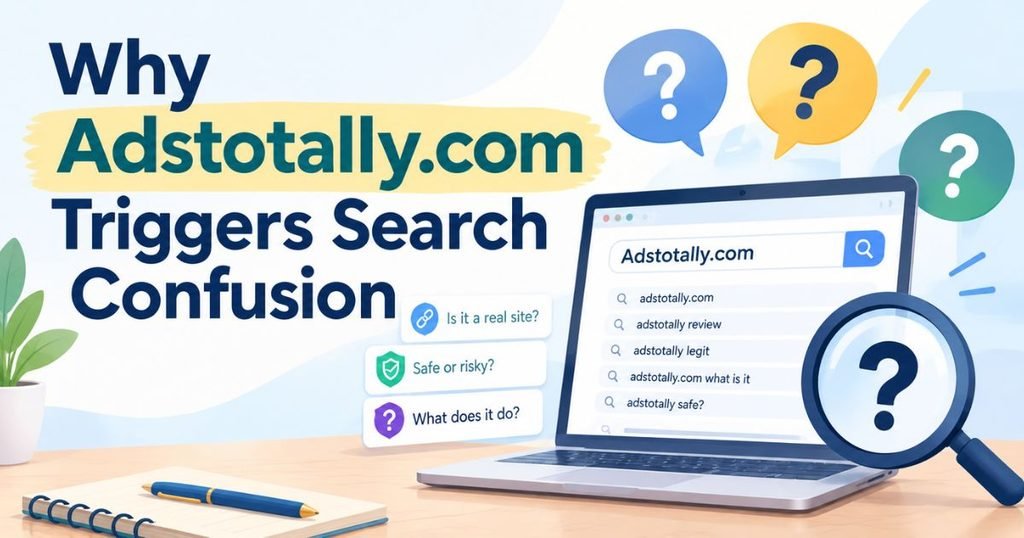
The brand name does most of the damage. “Ads” and “totally” together suggest a complete advertising solution, so people searching it often expect a network, an ad exchange or a monetization tool. When they find articles on finance, fashion and lifestyle instead, they start asking whether the site is legitimate. That mismatch drives a large share of the “is it safe?” searches.
Search data adds to the puzzle. The domain reportedly ranks third for its own exact-match keyword, with roughly 74,000 estimated monthly searches, yet only about 3,900 estimated organic visits. A large gap between brand searches and real traffic usually means many people are searching the name to verify it. They are not finding it through topical content.
Third-party “explainer” posts make this worse. Many are thin, repetitive and written to capture the same search phrase, and some describe the site in ways the evidence does not support. Readers who bounce between these pages end up with contradictory claims. A clear, evidence-based audit is the best way to resolve the confusion.
🔬 Audit Methodology & Verification Tools
Our audit separates three questions: what the site says it is, what public records show, and what independent traffic and security tools report. We start with the site’s own pages, including its slogan, category structure and visible publishing activity. We then compare that to domain records and third-party SEO data. Claims that appear in only one place are marked as unverified.
For technical checks, we recommend a standard toolkit. Use a WHOIS lookup for registration history, SSL Labs for certificate quality, and Google Safe Browsing’s Transparency Report for malware flags. VirusTotal adds a multi-engine reputation scan. For traffic, platforms such as Ahrefs, Semrush or Ranktracker give directional estimates, not exact figures.
We also review content freshness and editorial patterns, because they say a lot about how a site is run. Reports note that some categories contain 2026 posts while others, such as lifestyle, show nothing newer than April 2021. Uneven publishing suggests occasional commissioned content, not a steady newsroom. Any number from an estimation tool should be read as a range, not a fact.
📊 In-Depth Analysis: Misconceptions vs. Reality
The biggest misconception is that Adstotally.com is a functioning ad network, and the evidence points the other way. Analysts found no clear evidence on the site of an ad-management platform. What the site does show is articles and category archives, which is typical of a WordPress-style publication. Calling it an ad-tech company is therefore a misreading.
The second misconception is that high brand-search volume signals a big audience. In reality, the numbers suggest curiosity rather than loyal readership. Estimated organic traffic is about 3,900 visits a month, with an estimated traffic value of $0 and all measurable traffic coming from the United States. That is a small, narrow footprint for a site people search for so often.
The third point is more practical. Because the site publishes guest and commercial content, its value depends on who is buying and why. A link from a low-traffic site with irregular updates carries limited SEO benefit, and paid do-follow links can carry risk. Buyers should evaluate it on measurable traffic, not on how impressive the domain name sounds.
| Common claim | Reality check |
| “It is an ad network” | No clear evidence; operates as a general publication |
| “High searches mean high traffic” | Brand searches far exceed organic visits |
| “New and unproven domain” | Registered in 2018 and renewed to 2030 |
| “Guaranteed SEO value” | Traffic value estimated at $0; results uncertain |
1. The “Ad Network & Monetization” Myth
The name invites the assumption that the site sells ad inventory, runs campaigns or pays publishers. None of that is visible on the site. There is no advertiser signup flow, no publisher dashboard, no pricing for impressions or clicks, and no documentation for ad formats. Without these, the “ad network” label has nothing behind it.
This matters because people who believe the myth may send money or personal details expecting a service that doesn’t exist. Before engaging with any platform that claims to be an ad network, ask for a working dashboard, a published policy, and verifiable client references. If these are missing, the claim should not be trusted. Adstotally.com does not present these materials.
2. The Role of Low-Quality Third-Party “Explainer” Sites
A network of thin explainer pages has grown around the Adstotally.com name. Many are short, templated and keyword-stuffed, and they often repeat the same vague phrases about “digital marketing value.” They rarely include original data, screenshots or domain evidence. Their goal is to rank for the brand term, not to inform.
This creates a feedback loop. Each new explainer adds to the confusion and pushes more people to search the name, which raises brand-search numbers without raising real readership. Readers should favor sources that show their methods, cite verifiable records and state their limits. A trustworthy review tells you how it knows what it claims.
3. Monetization Model of Adstotally.com
The visible monetization model appears to be paid and sponsored content. Reported public guest-post pricing runs from about $77 to $120 depending on the seller. This suggests the site earns by selling placements, not by running ad technology. It is a legitimate business model when it is disclosed, but it differs sharply from an ad network.
Price spread is a signal in itself. When the same site is listed at very different prices across marketplaces, the metrics behind those listings are probably inconsistent. Buyers should ask for recent traffic proof, examples of existing posts, and clear disclosure terms. Never pay based on a marketplace score alone.
Also Like To Read This: Crackstube Explained: What Is Crackstube.com and Is It Safe to
🔒 Technical Infrastructure, Security & Privacy Audit
Technically, Adstotally.com looks like a standard WordPress-style publication behind Cloudflare. Cloudflare provides CDN caching, DDoS protection and a layer that hides the origin server, and it is widely used by legitimate and questionable sites alike. Its presence tells you the owner cares about uptime, but it says nothing about content quality or intent.
A proper security audit has four parts: registrant transparency, encryption, malware reputation and script behavior. Each one should be checked live, on the day you read this. Results can change quickly, because sites get compromised, change owners or add new third-party scripts. A clean result last month does not guarantee a clean result today.
Privacy deserves attention too. Any site that publishes commercial content may load analytics, tracking pixels or affiliate scripts. Check for a clear privacy policy, a cookie notice and contact details. A site that hides these basics deserves more caution than one that states them openly.
WHOIS & Registrant Transparency
Public WHOIS data shows the domain’s creation date, expiry date and registrar. For this domain, records point to an October 2018 registration that runs through October 2030. Many registrars now mask owner details for privacy, so a hidden registrant is common and not suspicious on its own. What matters is whether the site shows a reachable contact elsewhere.
Look for an About page, a working contact email and a named editorial or business contact. If none of these exist and the registrant is also hidden, accountability is low. That does not prove bad intent, but it raises the risk for anyone paying for placements. Always confirm who you are dealing with before sending money.
Transport Layer Security (SSL/HTTPS)
HTTPS encrypts the connection between your browser and the site. Check for a valid certificate that matches the domain, has not expired, and uses TLS 1.2 or higher. SSL Labs can grade the setup from A+ to F. A modern, valid certificate is now the minimum standard and is not a mark of special trustworthiness.
Also check for mixed content, where an HTTPS page loads images or scripts over plain HTTP. This triggers browser warnings and weakens protection. Cloudflare typically handles certificates automatically, which lowers the risk of an expired certificate. Confirm the padlock appears on every page you visit, including article and category pages.
Malware & Safe Browsing Status
Run the domain through Google Safe Browsing and VirusTotal. A clean result means no engine currently flags it for malware, phishing or unwanted software. Treat the result as a snapshot. Low-traffic sites are sometimes compromised and used to host hidden spam links that the owner never notices.
If you see any flag, do not interact with the site and report it to the relevant service. If the result is clean, still keep browser protection active and avoid downloading files from article pages. Sites with weak editorial oversight are more exposed to injected content than closely managed ones. Rescan before each major decision, such as buying a guest post.
Ad Network Script & Redirect Risks
Check what third-party scripts load when you open a page. Browser developer tools and extensions like uBlock Origin’s logger reveal which domains the page contacts. Legitimate sites usually load recognizable analytics and ad scripts from known providers. Unfamiliar domains, obfuscated code or auto-playing popups are red flags.
Redirects are the main danger. Forced redirects to unrelated offers, fake alerts or notification-permission prompts are typical of aggressive ad scripts. If a page sends you away without a click, close it and clear permissions. Reports reviewed for this article describe a content site, not a redirect-driven one, but verify the behavior yourself.
⚖️ Comparative Matrix: Adstotally.com vs. Legitimate Ad Tech Networks
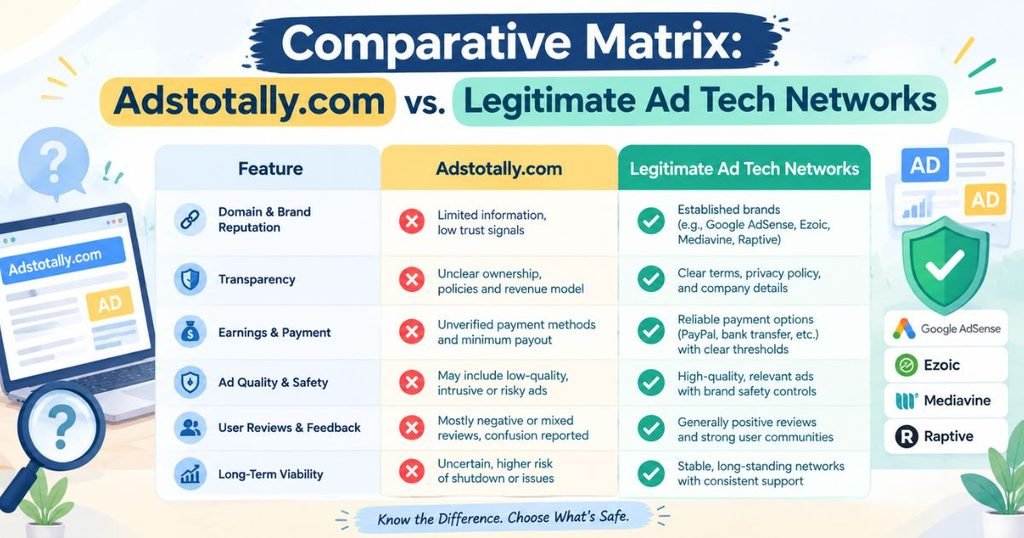
The table below shows how Adstotally.com compares with established ad networks on the features that define the category. The point is not to rank quality, but to show that the two are different kinds of businesses. A publication that sells guest posts and a network that serves ads at scale have different tools, different contracts and different accountability. Comparing them directly explains why the name misleads.
Real ad networks publish documentation, onboarding steps, payment terms and policy rules. They also have named support channels and public track records. When these elements are absent, the label “ad network” does not hold. Use the matrix as a quick checklist whenever you evaluate a new platform.
For marketers, the practical takeaway is to match the tool to the goal. If you want paid reach, use a real ad platform with reporting. If you want editorial placement, treat sites like Adstotally.com as one small option and judge it on traffic, relevance and disclosure.
| Criteria | Adstotally.com | Established ad networks |
| Core offering | General articles, guest posts | Ad serving, bidding, monetization |
| Advertiser dashboard | Not visible | Yes |
| Publisher payouts | Not visible | Yes, with published terms |
| Documented policies | Limited | Detailed and public |
| Organic traffic | About 3.9K/month (estimate) | Varies; not the main metric |
| Accountability | Limited public detail | Corporate entity, support, contracts |
🛡️ User Safety Guidelines & Recommendations
For everyday readers, the main guidance is simple: browse with normal caution. Keep your browser and antivirus updated, and never enter passwords, payment details or personal information on a general article site. If a page asks you to allow notifications or download something, decline. Most problems on content sites come from pop-ups and ads, not from the articles themselves.
For marketers and SEO buyers, due diligence matters more. Ask for recent traffic screenshots, a list of live guest posts, and the exact link type you are buying. Be wary of paid do-follow links, which search engines can treat as link schemes. Pay through traceable methods and keep a written record of what was promised.
If you manage a brand, monitor mentions of your company on sites like this. Paid placements should be clearly labeled as sponsored, and your content should not be edited without your approval. When in doubt, choose a publisher with verified traffic and clear editorial standards. A cheaper post that brings no readers is not a bargain.
🚀 Verified Alternatives for Digital Marketers & Publishers
If your real goal is advertising or monetization, several well-known platforms are better suited than a general guest-post site. They offer transparent policies, reporting tools and established payment systems. The right choice depends on your size, traffic and goals. Start by listing what you need, whether that is ad revenue, paid reach or brand exposure.
For learning and strategy, reputable marketing publications give far more value than low-traffic blogs. They publish original research, tested tactics and expert commentary, and they are accountable for their editorial standards. Following them keeps you informed about policy changes and industry shifts. They are also safer sources to cite in your own work.
Whichever route you choose, verify before committing. Check the company’s public presence, read independent reviews and test with a small budget first. Platforms that welcome scrutiny usually deserve more trust than those that avoid it. This habit protects you from both scams and wasted spend.
Recognized Ad Networks & Monetization Platforms
Google AdSense is the most familiar option for publishers who want to monetize content through display ads. It has clear approval criteria, public policies and regular payments. Media.net offers contextual ads and works well for sites with strong US traffic. Both are easy to verify and widely documented.
For publishers with larger audiences, Ezoic, Mediavine and Raptive provide managed ad optimization and typically pay better, though they set traffic minimums. For advertisers, Google Ads and Microsoft Advertising offer full campaign control and detailed reporting. Choose based on traffic level and the type of control you need.
Trusted Marketing & SEO Publications
Search Engine Journal and Search Engine Land cover algorithm updates, advertising changes and practical SEO guidance. Their reporting is consistent and widely referenced across the industry. They are a good first stop when you want to confirm whether a tactic is safe. Both clearly separate news from sponsored content.
For deeper research, the Ahrefs and Moz blogs publish data-backed studies and tutorials. Digiday and AdExchanger focus on ad-tech and media business news. Reading a few of these regularly will help you spot weak claims quickly. They also make better sources for link-building outreach than low-traffic guest-post sites.
❓ Frequently Asked Questions
Is Adstotally.com legit?
Adstotally.com appears to be a real, long-registered publication, not a scam site. Public records show the domain was registered in October 2018 and paid through October 2030. The caution is about what it is: a low-traffic general site that sells guest posts, not an ad-tech company. Judge it as a blog, not as a platform.
Is Adstotally.com an ad network?
No clear evidence says it is. The site shows articles and category archives, but no advertiser signup, publisher dashboard, ad formats or payout terms. Analysts reviewing it describe a general content and guest-post site. If you need real ad serving or monetization, use an established platform with published policies.
Is Adstotally.com safe to visit?
Nothing in the sources reviewed describes a malware-driven or redirect-driven site, but safety can change quickly. Check Google Safe Browsing and VirusTotal on the day you visit, confirm the HTTPS padlock, and decline any notification or download prompt. Never enter passwords or payment details on a general article page.
How much traffic does Adstotally.com get?
Third-party estimates put it at about 3,900 organic visits a month, with an estimated traffic value of $0 and all measurable traffic from the United States. Brand searches reportedly reach around 74,000 a month, so most people searching the name are checking it, not reading it. Treat all of these figures as rough estimates.
Does Adstotally.com accept guest posts, and what do they cost?
Reports describe it as a guest-post publication, with public listings priced at roughly $77 to $120 depending on the seller. Prices vary because marketplace metrics for the site are inconsistent. Ask for recent traffic proof, live examples and clear disclosure terms before paying anyone.
Who owns Adstotally.com?
We could not verify the owner. Many registrars hide registrant details, so a masked WHOIS record is common and not suspicious by itself. Look for an About page, a named contact and a working email before you send money for a placement.
Is a guest post on Adstotally.com worth buying?
Probably not for SEO value alone. Low traffic, uneven publishing and an estimated traffic value of $0 limit the benefit, and paid do-follow links can carry risk with search engines. If you still want to test it, start with a small budget and measure referral traffic.
✅ Conclusion
Adstotally.com is best understood as a general-interest publication that accepts guest posts, not an ad network. The evidence shows a domain registered in 2018 and paid through 2030, a Cloudflare setup, uneven publishing and modest estimated traffic of about 3,900 visits a month. Nothing in the sources reviewed points to a scam, but nothing shows ad-tech capability either.
The name is the main source of confusion. It promises more than the site appears to deliver, and thin third-party explainers have kept the “is it legit?” searches growing. Readers can browse with normal caution, while marketers should treat any placement as a small, unproven bet and demand traffic proof before paying.
Before you act, run your own live checks on WHOIS, SSL, Safe Browsing and page scripts, since those results change over time. If your real goal is monetization or paid reach, choose a platform with published policies and a working dashboard. Verify first, spend small, and measure the results.



Leave a Reply